


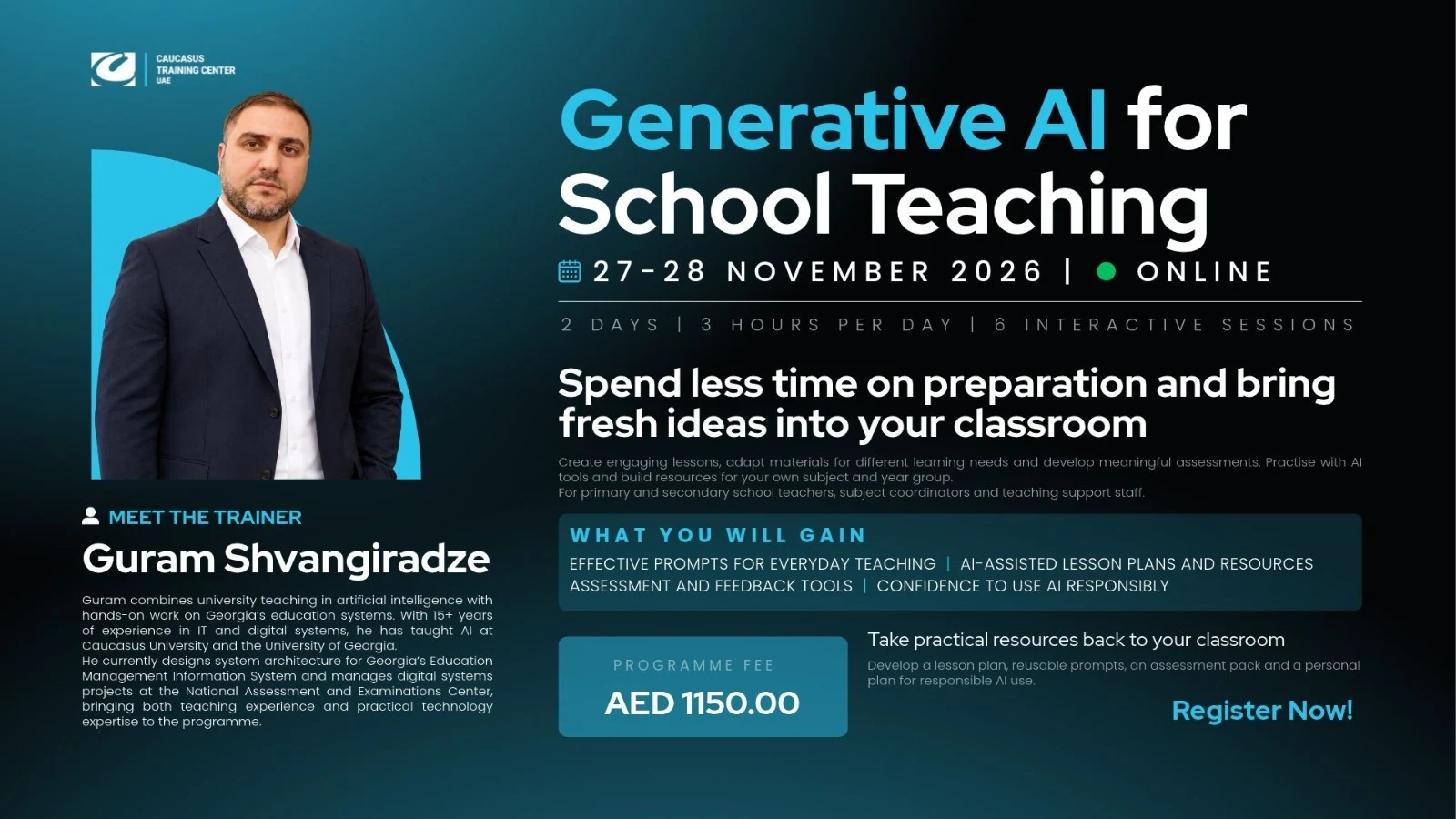
Generative AI for School Teaching, Learning and Assessment

Delivery Mode
Online

Duration
2 Days

Certificate
Yes

Language
English

Start Date
November 27/2026
Course Price
Package Name:
Price:
To explore alternative packages, please scroll down the page and make your selection.
Description
Join Guram Shvangiradze and discover how generative AI can help you create engaging lessons, adapt materials for different learning needs and develop meaningful assessments.
A practical program for primary and secondary school teachers, subject coordinators and teaching support staff.
Format: 2 days online (27–28 November 2026), three 60-minute interactive sessions per day, with practical activities, discussion, Q&A and follow-up assignments.
What you'll gain:
- Effective prompts for everyday teaching
- AI-assisted lesson plans and classroom resources
- Assessment and feedback tools
- Confidence to check AI outputs, protect pupil information and use AI responsibly
Take practical resources back to your classroom: an AI-assisted lesson plan, a reusable set of prompts, a reviewed classroom resource, an assessment pack and a personal action plan for responsible AI use – all built for your own subject and year group, not just theory.
Syllabus

The opening session explains how generative AI works and where it can support everyday teaching. Participants examine both its capabilities and its limitations, establishing a routine for checking and adapting anything they intend to share with pupils.
You will learn to:
- Distinguish traditional AI from generative AI and explain how a language model produces text
- Recognise why AI can generate confident errors, invented sources, biased content or outdated information
- Identify uses across school subjects, including drafting worksheets, simplifying explanations and varying practice questions
- Assess whether an output is accurate, age-appropriate and suited to the curriculum and local context
- Apply the teacher’s responsibilities to ask clearly, check facts, adapt to pupils, own the result and reflect on its use
- Begin a prompt journal and produce an annotated resource showing your corrections
Format: worked classroom examples, small-group review and discussion, followed by an individual resource-drafting task and prompt journal.
This session connects tool selection with lesson planning. Teachers learn to give AI a clear curriculum brief, evaluate the resulting draft and adapt materials for different ages, language levels and learning needs.
You will learn to:
- Compare general chatbots, education-specific platforms and assistants within familiar office and design tools
- Select an appropriate tool for a teaching task, taking account of school approval and account access
- Draft a lesson plan using a learning objective, year group, curriculum and pupils’ prior knowledge
- Check activities against the intended outcome, available time and evidence of learning
- Generate explanations and analogies at different levels while checking that the meaning remains accurate
- Adapt resources with language support, smaller task steps and extension work without sharing personal pupil information
Format: tool comparisons, a paired lesson-planning workshop and peer review, followed by completion of an AI-assisted lesson plan with a short change log.
The quality of an AI response depends on the brief it receives. Participants practise a reusable approach to prompting, then improve weak responses through focused follow-up instructions and build a prompt collection for their own subject.
You will learn to:
- Build a teaching prompt around role, context, task and requested output, adding constraints where useful
- Specify the year group, curriculum, prior learning, language level and required response format
- Write prompts for explanations, quizzes, differentiated texts, classroom scenarios and feedback
- Refine responses by changing the level, length, local context or depth of a task
- Identify common mistakes, including vague instructions, unverified facts and personal data in prompts
- Develop six reusable prompts and improve a weak section of the lesson plan created in Session 2
Format: prompt comparisons, paired writing and testing, peer feedback and a follow-up assignment to expand the teaching prompt set.
Teachers use their prompt-writing skills to create resources for upcoming lessons. The session covers written and visual materials, with particular attention to subject accuracy, inclusion and activities that encourage pupils to think and participate.
You will learn to:
- Produce lesson notes, revision summaries and bilingual glossaries suited to the intended readers
- Draft presentation outlines, slide text and speaker notes that follow a clear teaching sequence
- Generate age-appropriate stories, scenarios, role plays and problem-solving tasks
- Develop discussion questions that progress from recall towards reasoning and evaluation
- Plan visual resources and convert familiar worksheets or notes into interactive activities
- Review resources for accuracy, curriculum fit, inclusion, usage rights and privacy before classroom use
Format: worked examples, individual resource creation and partner review, followed by completion of a classroom resource and either an interactive adaptation or reasoning-question sheet.
AI can assist with question writing and feedback, while teachers remain responsible for assessment quality and marking decisions. Participants create an assessment pack and consider how to make pupils’ thinking visible when AI tools are available.
You will learn to:
- Distinguish formative and summative uses of AI and recognise when drafts require further moderation
- Generate multiple-choice, short-answer and case-based questions, using Bloom’s Taxonomy to vary the thinking required
- Check answer keys, distractors, mark allocations and the accuracy of assigned cognitive levels
- Build rubrics from learning objectives and the school’s marking scale, then test the descriptors on pupil work
- Turn feedback drafts into specific, actionable comments using anonymised material and approved tools
- Design assessments with visible process, oral explanation, classroom evidence and clear rules on permitted AI use
Format: worked assessment examples and a paired workshop, followed by a 10-question bank, a tested rubric and a revised feedback example.
The final session addresses the professional decisions behind classroom AI use. Teachers examine fairness, authenticity and privacy, then develop a realistic adoption plan that fits their school’s policies and their own teaching priorities.
You will learn to:
- Apply questions of fairness, safety, honesty and professional ownership to everyday AI use
- Recognise bias, misinformation and fabricated sources, and verify content through subject expertise and reliable references
- Acknowledge AI assistance appropriately in teaching materials and establish clear expectations for pupils
- Protect pupil information, check tool age restrictions and follow school approval processes
- Respond to authenticity concerns through task design and discussion, recognising the limitations of AI detection tools
- Identify the school policies and relevant UAE education guidance to check before adopting a tool
- Create a personal action plan with a teaching goal, safeguards, a dated first step and a review date
Format: ethical scenarios, guided discussion and an individual action-plan workshop with peer review, followed by completion of the plan and an optional classroom agreement or privacy audit.
Program takeaway: an AI-assisted lesson plan, a reusable set of prompts, a reviewed classroom resource, an assessment pack and a personal action plan for responsible use.

You may also like


 >6 Days
 6 Hours
AED 4,700.00
AED 5,500.00
15% off
 >8 Days
6 Hours
AED 6,500.00
AED 7,000.00
7% off
 >8 Days
6 Hours
AED 5,600.00
AED 7,000.00
20% off
 >3 days
6 Hours
AED 4,200.00

 >5 Days
6 Hours
AED 5,700.00
AED 7,900.00
28% off
